
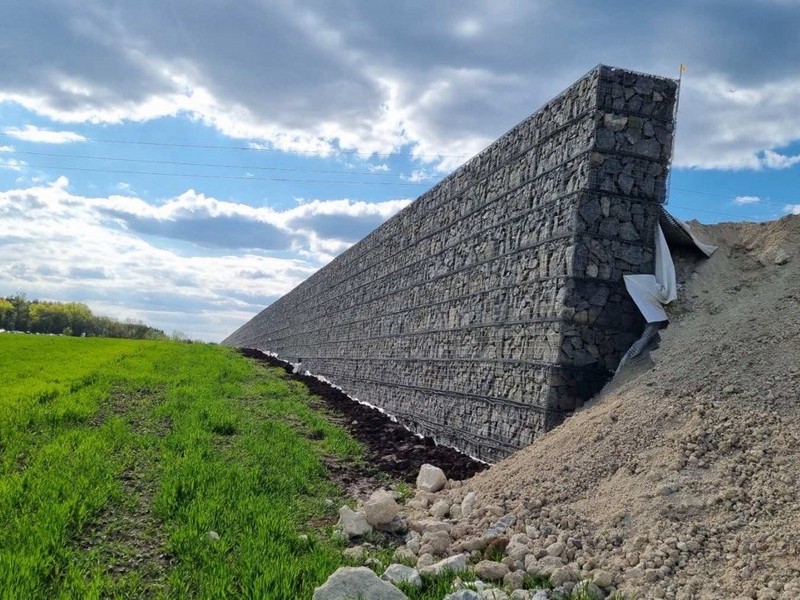
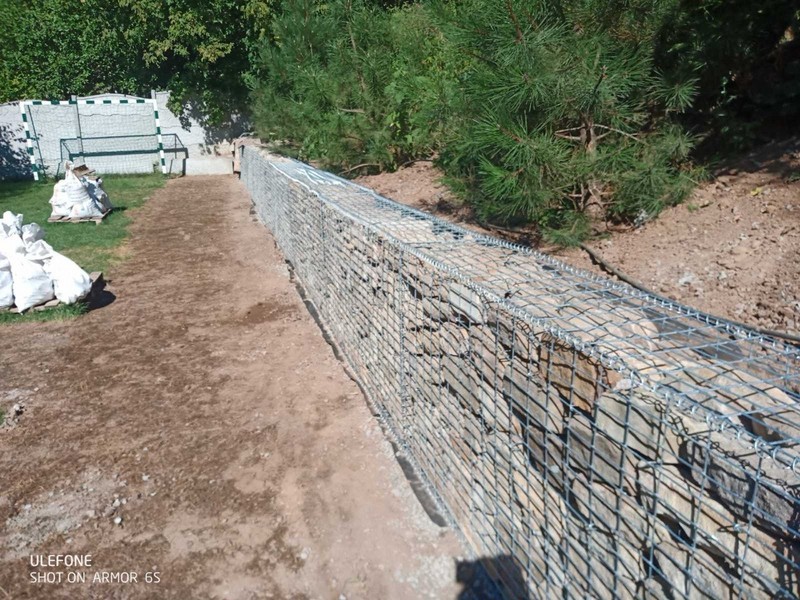
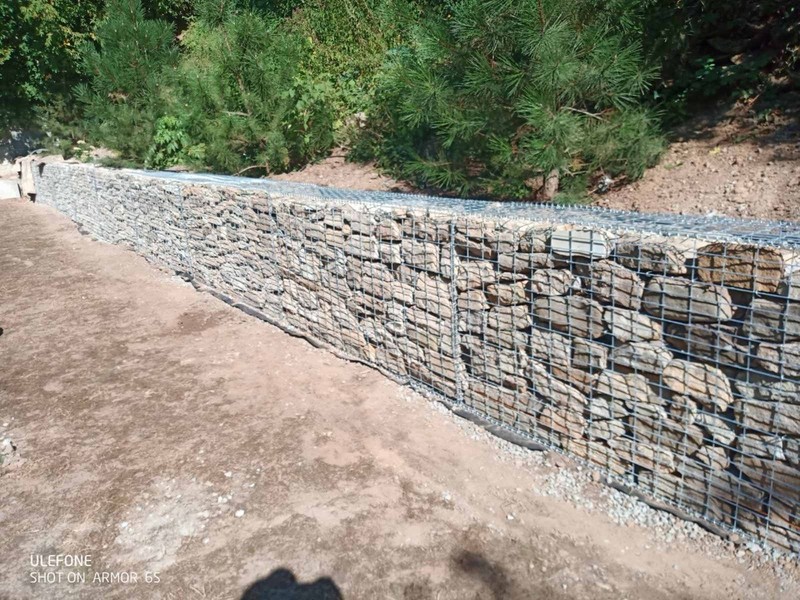
With its strength, the welded mesh construction retains all the advantages of standard gabions. They do not spoil the environment, fit into the environment, have excellent permeability, do not require special costs and qualifications during installation, and the cost is significantly lower than that of any known analogue of reinforcing structures. At the same time, they are incredibly durable and absolutely do not require post-installation maintenance, and as a result, they generally merge with the natural landscape, making it an integral part and increasing the margin of their strength and reliability.
Gabions are mainly used for the construction of retaining walls, strengthening of road and railway embankments, river and sea shore fortification, soil erosion stabilization and soil conservation. At that time, welded gabions are increasingly used in landscape works (especially in the foothills), in the creation of building structures, to create the latest design elements of the exterior of residential areas. Gabion boxes are installed, made of welded meshes of a given size, with spirals and stretchers, made of galvanized wire.
We produce welded meshes from GOST 3282-74 low-carbon general purpose steel wire. with a zinc coating, it is also possible to manufacture nets with a colored polymer coating. Grid dimensions: . wire diameter 4.0 mm; 5.0 mm. cell size from 50 mm * 50 mm to 200 mm * 200 mm (a multiple of 50 mm). canvas size: from 500 mm * 500 mm to 2500 mm * 5000 mm. Fastening spiral: made of galvanized wire d 4.0 mm: pitch of turns: 25 mm; the inner diameter of the spiral is 25 mm.
Fastening rod (stretch): is a rod made of galvanized wire d 4.0 mm. It is installed inside the box diagonally, attached to the bars of the perpendicular walls. It serves to give additional strength to the walls of the gabion, with a breaking force. It is also used to connect gabions to each other. In this case, it is passed through convoluted carbon spirals.
The use of gabions in landscape design: which ones are common and how to make them with your own hands. How and when you can use gabions on your home plot Beds made of gabions
Uses of gabions and gabion structures
Order this product
Thanks to their unique characteristics, the use of gabions and gabion structures has become widely used. They allow you to save a lot of costs for other building materials, simply in the installation and do not require large labor costs for both installation and further operation. In addition, it is ecological, permeable and most importantly, durable. You feel the expediency of using gabions almost from the first days after their installation.
Many decorative elements for the garden can be created from gabion structures. Thanks to their rectangular or square shape, they are easy to connect with each other, and form complex, original and whimsical compositions. For the garden, gabions are suitable as garden furniture - a table, a chair or a bench. You can build a stone staircase from them, for which they are built in several layers. Using these designs in screen rollers, you can divide the space, zone it, dividing it into separate sectors. In these cases, gabion structures made of stone can also perform the functions of a kind of wallpaper, potted plants and flowers.
Field of application of gabions
- Soil reinforcement
- Protection against soil erosion, soil stabilization;
- Reinforcement of slopes and slopes
- Fighting ravines
- Stabilization of soil erosion and soil conservation
- Protection from snow avalanches, mudflows
- Protection against rock falls, landslides, landslides.
- Fortification of slopes and banks of rivers, lakes, reservoirs
- Lining of canals and construction of dams
- Protection of bridge piers
- Protection of underwater pipelines
- Retaining walls
- Strengthening of road embankments
- Construction of a terrace, design and improvement of the landscape and three-dimensional sets of structures for landscape works
Flexibility: Subjected to alternating tensile and compressive forces, the flexibility of the present gabion structure allows it to deform rather than collapse. This transforms the potential of constructive efficiency. Deformation in response to foundation settlement or internal stress is a functional characteristic, not just a disadvantage, but rather an advantage.
Strength: Since gabions are connected to one another as a monolithic element, the wire mesh is very easy to stretch. The wire mesh shell is not just a container for masonry, but also a reinforcement of the entire structure. Additional strength is achieved through the use of vertical diaphragms. These diaphragms are attached to the base of the gabions to limit the internal movement of the stone and provide further reinforcement. Gabion effectiveness, instead of decreasing with age, increases on the spot.
During the early periods of use, silt and vegetation will accumulate within the stone embankment, forming a naturally stable structure, improving the environment.
Permeability The intermediate spaces in the stone aggregate inside the baskets provide a high degree of strength throughout the structure, external demand in the system and prevention of the accumulation of hydrostatic pressure, which leads to displacement and cracking of concrete structures. Therefore, during physical works, the pressure and resistance on the banks due to the different depth of water between the flood and low water are also eliminated.
Economy: wire mesh gabions are cheaper than most building materials. Graded stone fill is usually available on site. Waste materials such as crushed concrete may be specified in place of stone.
Construction costs are decreasing; unskilled workers can easily learn how to install modular gabion systems, fill them and close them properly. Many gabion structures can be built without any mechanical equipment. Peelings, underwater drainage systems and earthworks are not required. There is no need to drain the site or build a rubber dam for the underwater installation. The first layer of gabions can be laid in water or mud.
Upon completion of construction, the gabion structure will immediately be fully loaded — without waiting periods of up to one month, usually associated with concrete structures. Gabion structures practically do not require maintenance.
The gabion mesh can withstand a breaking load of up to 5 t/linear meter. This allows gabions to be resistant to practically different types of loads.
Box gabions are quite flexible and have a strong base filled with stones or other filler, which is used to strengthen embankments, ravines, slopes, as well as ravines, roads and bridge structures. It is effective to use box-shaped volumetric gabions for the protection and stabilization of coastal structures, bridges (supports, cones), dams and earthen soil.
Gabion structures support the absorption of soil sedimentation without destroying the object. This is an important quality, especially in conditions of low soil stability and places of soil erosion. The soil in the empty places of the gabions is gradually compacted, and the gabions naturally become a friendly natural environment. The absence of hydraulic loads, drainage and stability of the structure protect the slopes well.
Minimal costs for operation, a minimum of work during the preparation of the base. Structural simplicity makes it possible to do without highly qualified labor during installation. Thanks to the sensitivity, there are no costs for the arrangement of the drainage system. The lack of vegetation protection and merging with nature makes building elements decoration of the geolandscape.
Gabions are filled with natural stone, usually crushed stone (but jackdaws and small boulders are also acceptable). At the same time, the stones should be larger than the grid cells. As a rule, the crushed stone fraction is 70-150 mm. The stone material must have high density, reliability, frost resistance, especially in gabion structures, enhanced dynamic impact of water.
After the containers are filled with stone material (up to 80-90% of the total amount of work on the assembly of gabion structures is carried out manually), a building element is formed - a gabion with a porosity of 30-40%. Over time, the free volume of pores is replaced by soil particles, after a few years, the gabion structure is fully consolidated, after which it acquires maximum stability and can serve for an unlimited time.
After the consolidation is completed, even a violation of the integrity of the metal mesh cannot cause the destruction of the structures, since the soil particles accumulated in the gabions are compacted and firmly cement the stone form of the gabions. It should be emphasized that each gabion is attached to the adjacent galvanized wires, which makes the whole structure monolithic.
